Design Rules for
Micro-Fabricated Piezoresistive Sensors

FEA-Based Optimization for Wearable Pulse Monitoring

📄 Co-Author Publication: Micromachines, 2022, 13, 838
DOI: 10.3390/mi13060838
Journal: Micromachines (Open Access)
Role: Co-author - Validation, data analysis, writing & editing
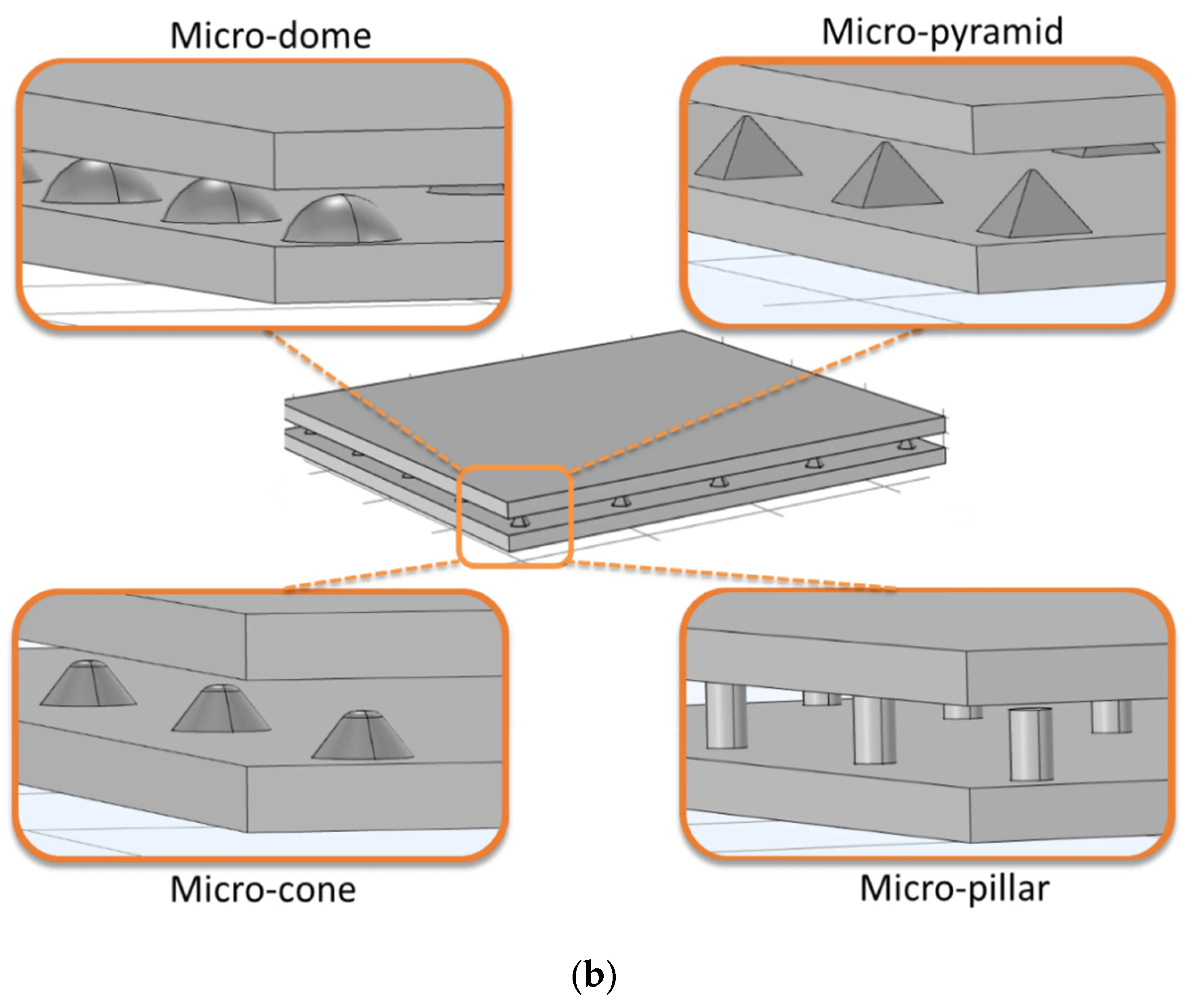
Micro-dome
Micro-pyramid
Highest Sensitivity Shapes
10⁵ S/m
Optimal Conductivity (Gold coating)
3 mm⁻¹
Optimal Feature Density
100 μm
Optimal Feature Size
50-60°
Optimal Pyramid Angle

Project Overview

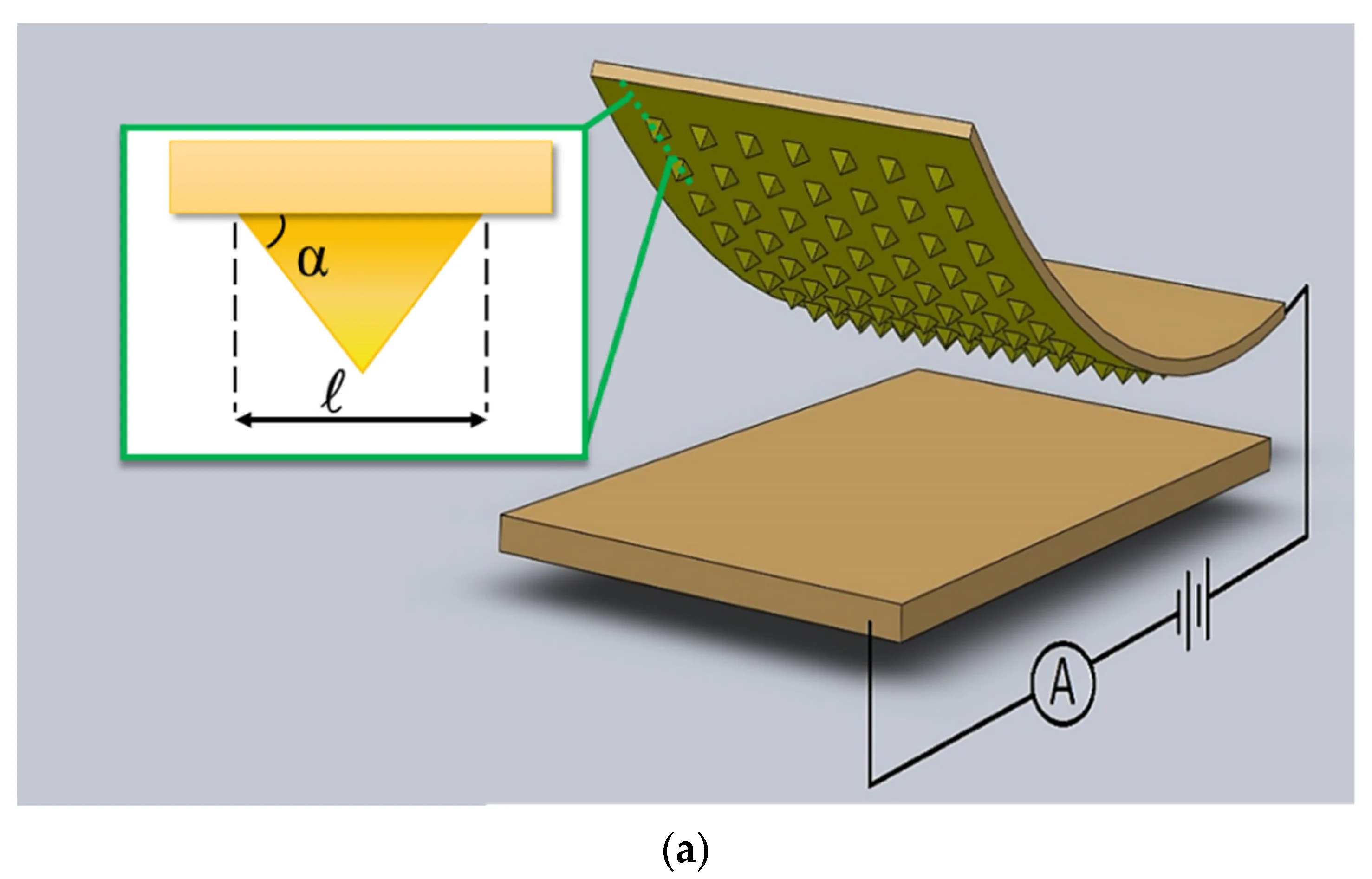
This research establishes design rules for highly sensitive piezoresistive pressure sensors using finite element analysis (FEA) in COMSOL Multiphysics. The study addresses a critical gap in the literature: while many micro-patterned piezoresistive sensors have been developed, there are no systematic design optimization guidelines. The work provides quantitative recommendations for micro-feature shape, material conductivity, spatial density, feature size, and pyramid angle to maximize sensitivity and current output for wearable pulse wave monitoring applications.

Problem Addressed

  • Most piezoresistive sensors output nanoampere-range currents, requiring bulky sourcemeters for signal acquisition
  • No design rules exist for optimizing micro-feature geometry in piezoresistive sensors
  • Trade-off between sensitivity and linearity not systematically studied
  • Need for milliamp-range output to enable truly wearable signal acquisition with simple electronics

Simulation Methodology

COMSOL Multiphysics Setup:

  • Physics Interfaces: Electric Currents (ec) + Solid Mechanics module
  • Formulation: Arbitrary Lagrangian-Eulerian (ALE) method for large deformation problems
  • Contact Algorithm: Augmented Lagrangian method (more accurate than default penalty method)
  • Mesh Type: Free tetrahedral with "extremely fine" size calibration
  • Convergence Criteria: DOF increased to 1000% until results varied <5%

Simulation Parameters:

}

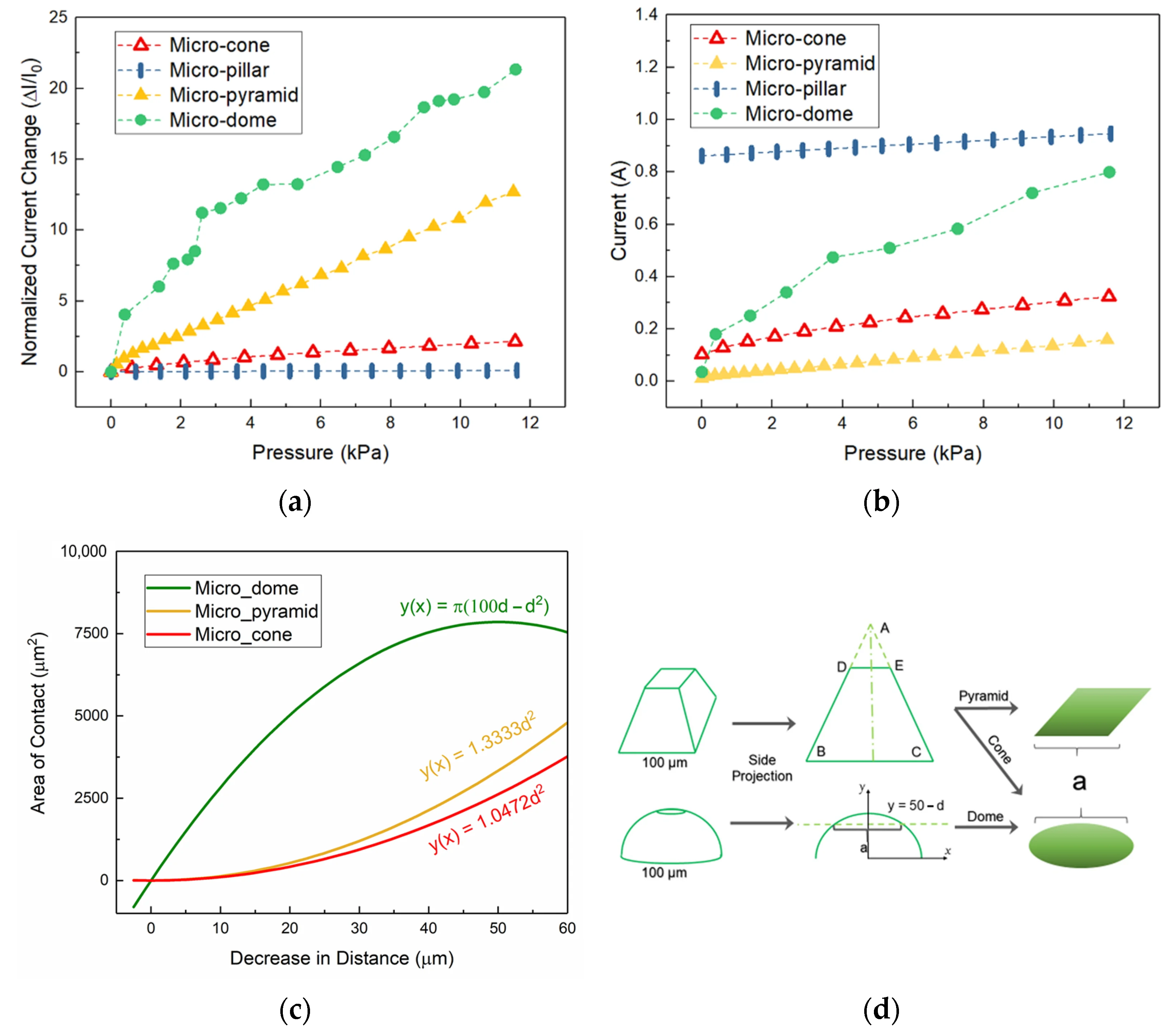
Results 1: Micro-Feature Shape Comparison

Ranking by Sensitivity (0-12 kPa range):

  1. Micro-dome - Highest sensitivity (but non-linear response)
  2. Micro-pyramid - Excellent sensitivity + linear response (best overall)
  3. Micro-cone - Moderate sensitivity
  4. Micro-pillar - Lowest sensitivity (good for digital switching applications)

Analytical Derivation of Contact Area:

Using Thales theorem, the contact area for each shape was derived:

Pyramid contact area: Sₚ = 1.3333 × d²

Cone contact area: S꜀ = 1.0472 × d²

Dome contact area: Sᴅ = π × (√(100d - d²))²

Where d is the displacement (layer spacing decrease). These analytical equations match COMSOL simulation results, validating the model.

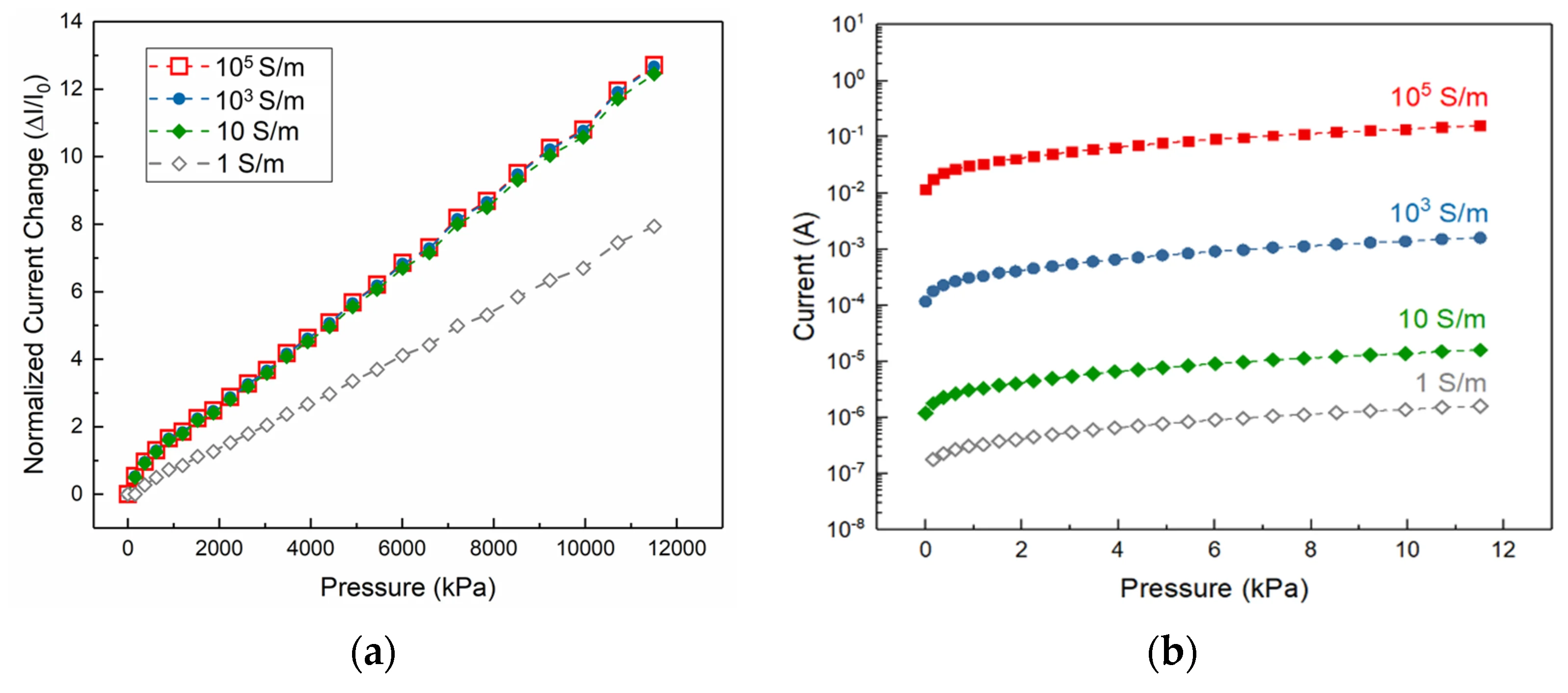
Results 2: Effect of Material Conductivity

Key Findings:

  • Sensitivity saturation: Sensor sensitivity saturates at elastomeric layer conductivity of 10 S/m
  • Below 1 S/m: Sensitivity deteriorates significantly (typical of CNT-PDMS composites)
  • Gold coating (10⁵ S/m): Current output in milliamp range (vs. nanoamp range for conductive polymers)
  • Higher current = Higher SNR = Simple electronics (Arduino, ESP32) instead of bulky sourcemeters

Conductivity Recommendations:

ParameterMicro-Patterned LayerCurrent CollectorReference
Feature Angle (α)57.4°N/A[40]
Feature Base Size (ℓ)100 μmN/A-
Feature Spacing300 μmN/A-
Array Size5×5 (low density)N/A-
Footprint1.8×1.8 mm²1.8×1.8 mm²-
Conductivity1×10⁵ S/m46×10⁶ S/m[41]
Young's Modulus750 kPa70 GPa[41,42]
Poisson's Ratio0.490.44[41,42]
Density970 kg/m³19,300 kg/m³[41,42]
Relative Permittivity2.751[41,42]
}

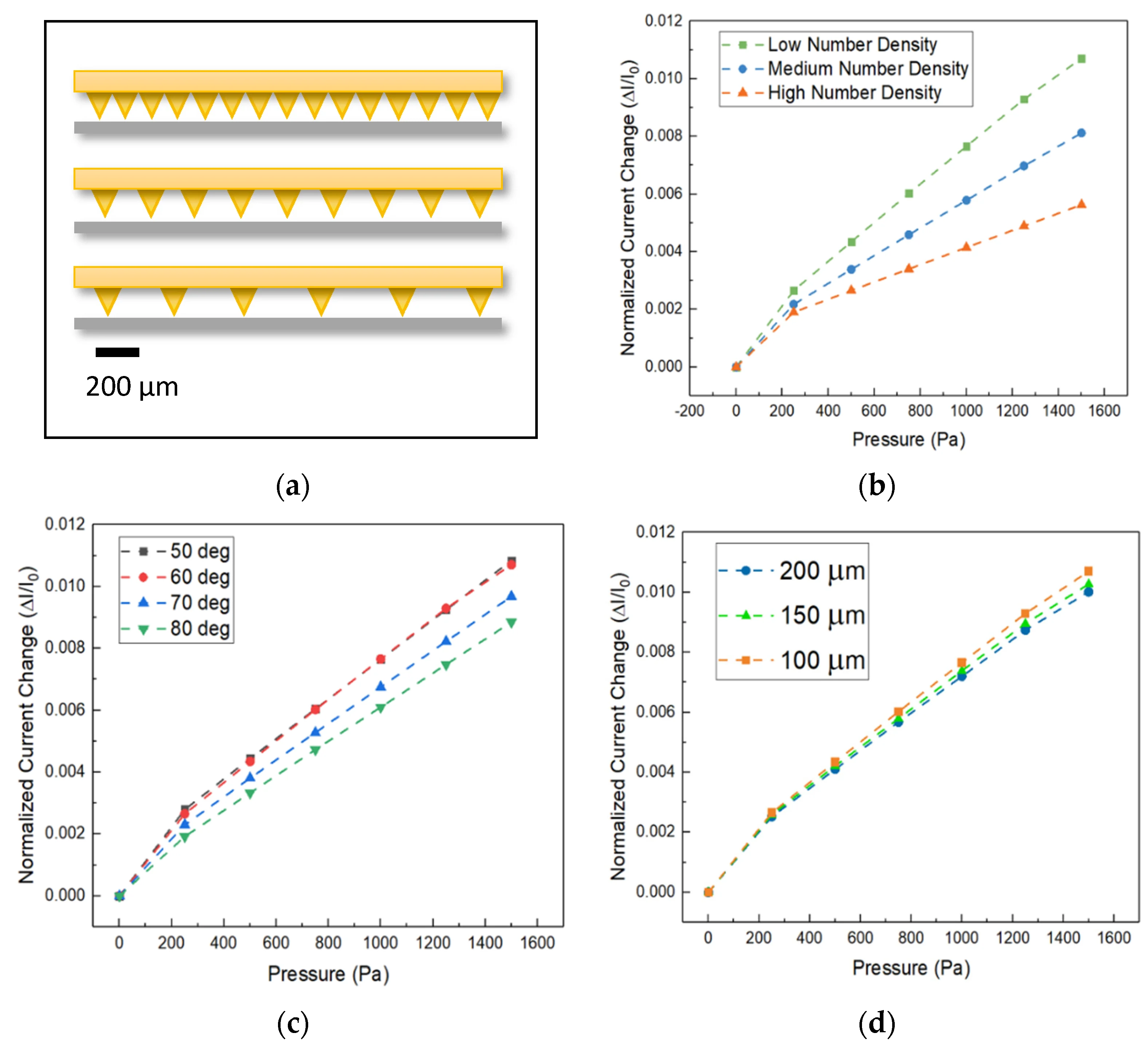
Results 3: Geometric Parameter Optimization (Micro-Pyramid)

A. Spatial Number Density:

  • Low density (3 pyramids/mm): Highest sensitivity (pressure concentrated at fewer contact points)
  • Medium density (4.5 pyramids/mm): Moderate sensitivity
  • High density (7 pyramids/mm): Lowest sensitivity (pressure distributed across more pyramids)
  • Optimal recommendation: 3 pyramids per millimeter

B. Pyramid Angle (α):

  • Optimal range: 50° - 60°
  • Balance between contact area growth rate and localized pressure
  • Angles <50°: High contact area growth but low localized pressure
  • Angles >60°: High localized pressure but low contact area growth

C. Feature Base Size:

  • Optimal size: 100 μm
  • Smaller features → higher localized pressure → higher sensitivity
  • Tested sizes: 100 μm, 150 μm, 200 μm (all with 60° angle, low density)

Summary of Design Rules

Conductivity RangeMaterial ExampleCurrent OutputRecommendation
<1 S/mCNT-PDMS compositesNanoamp range❌ Not recommended (poor sensitivity)
1-10 S/mSome conductive polymersMicroamp range⚠️ Marginal
>10 S/mMetal-coated elastomersMilliamp range✅ Recommended (gold, zirconium nitride)
}

Governing Equations

Charge Conservation (Continuity Equation):

∇·J = Qⱼᵥ

Current Density:

J = σE + Jₑ

Electric Field Strength:

E = -∇V

Where: J = current density, σ = electrical conductivity, E = electric field strength, V = electrical potential, Jₑ = externally generated current density.

Practical Implications for Wearable Sensors

Current Output Comparison:

  • Conductive polymer sensors (CNT-PDMS): ~nanoamp output → requires bulky sourcemeter
  • Gold-coated sensors (this design): ~milliamp output → readable by Arduino/ESP32

Enabling Truly Wearable Systems:

  • High current output eliminates need for expensive, desktop-sized sourcemeters
  • Simple voltage divider circuits + development boards (Arduino Nano, ESP32) sufficient
  • Higher signal-to-noise ratio enables reliable pulse waveform detection
  • Battery-powered operation possible (1000 mAh LiPo)

Software & Tools Used

  • COMSOL Multiphysics (FEA)
  • Electric Currents (ec) Interface
  • Solid Mechanics Module
  • Arbitrary Lagrangian-Eulerian (ALE) Method
  • Augmented Lagrangian Contact Algorithm
  • Free Tetrahedral Meshing

Downloads

My Contributions

  • Validation of simulation results against experimental data
  • Data analysis and interpretation
  • Manuscript writing, review, and editing

Funding

  • National Science Foundation (NSF) PATHS-UP ERC (Award #1648451)
  • NSF Awards #2126190 and #2107318

Related Publications

  • Jafarizadeh, B., Chowdhury, A.H., Khakpour, I., Pala, N., Wang, C. "Design Rules for a Wearable Micro-Fabricated Piezo-Resistive Pressure Sensor." Micromachines, 2022, 13, 838.
  • Jafarizadeh, B., Chowdhury, A.H., Sozal, M.S.I., Cheng, Z., Pala, N., Wang, C. "Hardware and Protocol for Testing of Piezoresistive Pressure Sensors for Pulse Wave Monitoring." IEEE Sensors Letters, 2023, 7(8), 2502304.
  • Jafarizadeh, B., Chowdhury, A.H., Sozal, M.S.I., Cheng, Z., Pala, N., Wang, C. "Wearable System Integrating Dual Piezoresistive and Photoplethysmography Sensors for Simultaneous Pulse Wave Monitoring." ACS Applied Materials & Interfaces, 2024, 16, 65402-65413.

Conclusion

This study established the first comprehensive design rules for micro-fabricated piezoresistive pressure sensors using finite element analysis. Key findings include: (1) micro-domes and micro-pyramids offer highest sensitivity, with pyramids providing better linearity; (2) material conductivity must exceed 10 S/m (preferably gold coating at 10⁵ S/m) to achieve milliamp current output for wearable signal acquisition; (3) optimal geometric parameters are 3 features/mm spatial density, 100 μm feature size, and 50-60° pyramid angle. These design rules enable the development of truly wearable pressure sensors that can be read by simple, low-cost electronics (Arduino, ESP32) instead of bulky sourcemeters, advancing the field toward practical, continuous cardiovascular monitoring.
Email

achow030@fiu.edu

azmalchowdhury93@gmail.com

Social

Design ParameterOptimal ValueReason
Micro-feature ShapeMicro-pyramid or Micro-domeHighest sensitivity; pyramid offers better linearity
Material Conductivity>10 S/m (Gold coating: 10⁵ S/m)Ensures high sensitivity and milliamp current output
Spatial Number Density3 features/mm (low density)Concentrates pressure for greater deformation
Pyramid Angle (α)50° - 60°Balance between contact growth and localized pressure
Feature Base Size (ℓ)100 μmSmaller features increase localized pressure
Footprint Area1.8×1.8 mm²Matches radial artery diameter (~2.3 mm)